Showing posts with label jam jars. Show all posts

Sunday, November 27, 2011

What's French for 'I Surrender'?

Readers waiting breathlessly for my recap of Thursday's Top Chef: Texas will, I'm afraid, be suffering disappointment this week. Despite four days' passing and the temptations provided by a hot-pepper Quickfire and chili cook-off elimination challenge, I have so far been unable to sit down with my DVR to enjoy the spectacle.

Thanksgiving, of course, intervened. Once again, I am forced to question the judgement of Bravo's producers: how can fans such as myself, with Turkey-Day cooking commitments of our own, possibly be expected to spend a whole hour watching TV? It's not possible.

I had planned to get caught up on the cheftestants' latest adventures on Friday but fate once again intervened. It intervened on Saturday, too. And today. In fact, I'm not sure I'm going be able to see TC:T at all before the DVR - full to bursting with Sir's and the Kid Squid's crime procedurals and sci-fi sagas - wipes my favorite show from its memory forever.

And who, you might wonder, is the fell transgressor in this saga? What sinister individual has unforgivably come between me, Pads, and the HM?

Can you guess?

That's right, Campers. Madame has struck again.

* * *

It started as a very simple plan, really. Several weeks ago I purchased two boxes of lovely little tulip-shaped Weck jars for the particular purpose of filling them with Christine Ferber's chestnut jam and giving them away as holiday gifts to sundry special folks. I adore candied chestnuts (marrons glaces and the Japanese dessert monburan are two of my favorite things in the whole wide world) and have been intrigued by the jam recipe ever since I first purchased Mes Confitures last Spring.


As a public service to readers I offer the recipe below, together some additional details garnered through the hard experience of Yours Truly.

Are you sitting comfortably? We shall begin.

Ahem.

Make a deep cut in each chestnut with the point of a knife.

Did I mention the recipe called for three pounds of whole uncooked chestnuts? That's a lot. Also, the shells are extremely durable. Using my priceless Japanese paring knife with the watered steel blade I was able, at the cost of severe blistering to my right thumb and index finger, to make deep gouges on the nuts' flat sides. Reasoning that one always cuts a cross into roasted chestnuts to facilitate peeling, I had at it with these bad boys as well. Fearing the worst (a premonition, perhaps), I made a big X on each of their curvy sides, too. It took forever and was extremely dangerous, what with an exceedingly sharp tachi, increasingly slippery cutting board, and customary Ferber-induced anxiety.

Put the chestnuts in boiling water. After three minutes you will be able to remove the outer shell and the inner skin. Chestnuts can be easily peeled if they don't cool off.

I looked at the daunting pile and realized there was no way I could cook them all at once if they were to stay warm for peeling. I decided, therefore, to cook them in batches of five. After the stipulated three minutes, I pulled the first lot out of the water. Although the tough outer shell came off, the brown-paper inner skin stuck stubbornly to the flesh beneath, causing angst and vexation on my part. I threw the nuts back into the pot for additional boilage and was eventually able to peel them with some success. After experimenting with several hundred specimens, I concluded ten minutes was the minimum processing time required for straightforward shell removal.

Sir, alarmed by my cursing and impatient slamming of pan lids, came into the kitchen, bless him, to see if he could help. I called his bluff and set him to work peeling. After some initial whining about the effects of the red-hot chestnut epidermi on his delicate fingers, he settled down and performed admirably. An hour into our task, I asked him if he wouldn't rather be outside raking leaves. He responded that there was nothing in the world he would rather do than provide jam-making assistance and redoubled his efforts.

Psychologists, take note.

Roughly two hours after I first brought my water to the boil, we had two pounds of warm peeled chestnuts. They looked like small tan-colored brains ...


... and I was already sick of the sight of them. 'Never mind,' I thought. 'From this point forward the recipe seems like child's play!'

In a preserving pan, combine the chestnuts with four and two-thirds cups sugar, one and three-quarters cups water, and a vanilla bean. Bring to a boil and cook for fifteen minutes, stirring gently. The chestnuts will be soft.

Soft my eye! After fifteen minutes of cooking my chestnuts were still the texture of driftwood. Thinking that perhaps I was supposed to have chopped them into pieces before introducing them to their bath (no, Madame never said I had to, but one has to be a bit of a mind-reader where Mes Confitures is concerned), I removed them from the molten sugar lava and gave them a rough chop on my cutting board.

Back into my maslin pan! I cooked them for a further ten minutes. Then ten minutes more. Finally, forty minutes had elapsed and my chestnuts were kind of soft, sort of. Not cooked exactly, but not the consistency of an antique oaken chair leg, either. More importantly, the syrup had by this time reached 220 deg F, betokening imminent crystallization should I not get the contents off the heat ASAP.

Pour the mixture into a ceramic bowl. Cover with a sheet of parchment paper and refrigerate overnight.

Oh, for crying out loud. I used a Pyrex bowl like a normal American and covered it with plastic wrap. I couldn't put it in the fridge because it was already nine o'clock at night and the contents of the bowl were still mad hot. I could have returned to the kitchen later that night, I suppose, but the adjoining family room was disturbingly full of huge pizza-eating teenage boys. Under such circumstances, I try to keep my distance from that end of the house.


Next day, bring the preparation to a boil, stirring constantly. Remove the vanilla bean. Crush the large pieces of chestnut with a wooden spoon.

Is anybody keeping track? At this point I was 24 hours into my consternating confiture contretemps. Of course, that is no more than an academic point because I never got to this stage of the recipe. In the cold light of day I realized my chestnuts were still tooth-challengingly hard. I couldn't return them to the stove for extra cooking whilst they were in their syrup (and yes, a few accusatory crystals were already forming about the edges of the bowl) so I rinsed them well and returned them to a pan full of boiling water.

After another half hour of cooking, they became soft. Also tasteless. The long boiling had leeched every ounce of flavour from the precious $15 supply over which Sir and I had labored so long. After consigning the glop to my garbage disposal I considered my options and decided that Madame had left the recipe unfinished.

I've taken the liberty of completing her work.

You don't want to peel three more pounds of chestnuts, do you? That's why god invented vacuum packs. Get into your silver Element and drive to the supermarket. Present yourself in the produce section and buy the last two packs of pre-cooked and pre-peeled organic Italian chestnuts ($4.99 for 6 ounces!) and one jar of French beauties from the baking aisle ($9.99 for seven ounces!). Decide that you cannot possibly afford to make the full recipe and conclude that half will be sufficient for your purposes. How many people do you know that really deserve homemade chestnut jam, anyway?

Take your chestnuts home and taste the Italian ones. Realize that they are stupefyingly disgusting and cannot possibly be used as anything but garden mulch. Ponder your jar of French marrons sadly but with resolve. Do some quick mental math and realize that you can produce  roughly one-quarter of Madame's recipe with minimum fuss. Pop the nuts (already soft and scrummy-tasting, praise be) into your maslin pan with one and one-sixth cup of sugar and seven-sixteenths cup of water. Don't forget to retrieve the vanilla bean from your failed batch of jam! Bring the water to a boil and continue to cook until the syrup reaches 220 deg F. Pour the mixture into a very small Pyrex bowl and cover with plastic wrap.

Since it's now after dark on the second day, you should probably have a stiff drink and maybe go to a movie. Not necessarily in that order.

The next morning (Day 3!), whizz up the mixture in your food processor using the big metal blade that looks like the sort of fearsome implement you might find in a defunct sawmill. Scrape the jam into a very small saucepan and bring to a boil. Put a little bit of the vanilla bean into each jar and pour the jam over. Madame never reveals the yields for her recipes, but I will: one-quarter of her original ingredients produces eleven ounces of chestnut jam - less than two little Weck tulip jars.

Sigh deeply and survey all the empty jars arrayed upon the table before you. Whip up some pineapple conserves with some fruit you bought on special offer a few days ago and the leftover vanilla beans.


Vow never ever to be tempted by one of Madame's recipes again. Not even in a million years.

Or until next time. Whichever comes first.

Coming soon: whilst enjoying my annual gala lunch with DMR at Le Bernardin this Thursday, I also manage to miss the next episode of Top Chef Texas.

Thursday, July 21, 2011

Ahead of the Curve

Yesterday I received my mysterious monthly issue of Bon Appetit, gratis and snail-mailed right to my front door. You may recall that I have been somewhat bemused by these regular deliveries, offering as they do dubious gluten-free recommendations, tantalizing but ultimately inauthentic recipes, and product placement of the most egregious sort.

However, I dutifully flip through them before I consign them to the recycling bag just to ensure I am not missing anything important in the wonderful world of advertising. After all, one never knows from whence the next great culinary inspiration will spring, does one?

Imagine my surprise when I discovered that, for the second time this year, I have beaten to the punch Those On the Forefront of Trends. What is it that floppy-haired, skinny-jeaned, sockless, retro-glasses adorned twenty-somethings are up to when they're taking time off from their jobs with graphic design firms, environmental NGOs, and second-hand vinyl boutiques?

Why, they're jamming up a storm, of course, preserving and pickling their little hearts out! Bon Appetit told me so in an eight-page spread devoted to a group of Los Angelinos with names like Josh, Ryan, Ashley and Mackenzie (OK, I made those up) who do just that.

And in what sorts of vessels are the Kids' vinegars, syrups, conserves, and jams resting quietly, waiting for rebirth this winter?

Glass jars courtesy of the noble firms of Ball and Weck, of course!

In a life characterized by utter geekiness and a woeful lack of cool, it's not often I'm able to say, 'Been there, done that.'

Pineapple pickle with pink peppercorns (pint Ball jar)
and blackberry and apple conserve (Weck 0.2 litre mold jar):
so three weeks ago!

Friday, July 1, 2011

Nick of Time

Still smarting from my camembert crack-up, today I was greatly cheered by my friendly UPS man who - no doubt out of concern for my emotional well-being and fully cognizant of the beneficial effects that his all-too-infrequent deliveries have upon my mental outlook - left a surprise on my front porch while I was at work.

What excitement! What anticipation! My disappointment over my dried-up fromages evaporated as if by magic.

But whatever could it be?


I eagerly - but judiciously - slit the packing tape with my favorite Stanley knife, liberated from laboratory duties some weeks ago. I peeled back the box's top flaps, but was still none the wiser.


I worked my way down through the packing peanuts, excavating layer by layer like some frenzied paleontologist unearthing a mastodon. I was rewarded by the discovery of five additional boxes - small, admittedly, but heavy and laden with possibilities.


I opened each one, almost breathless with expectation.

And what did I discover, nestling in little cardboard cocoons, protected against the vagaries of potholes, sudden stops, and sharp right-hand corners taken at speed?


My new Weck jars, in three different cunning shapes and sizes! Yes, I have decided to try jars with actual glass lids, old-fashioned rubber seals, and honest-to-goodness clips just like in the good old days.

What could be a more felicitous than the arrival of elegant gift-worthy preserving apparatus at the beginning of a three-day weekend - and just as all the stone fruit has started to appear in the shops, too?

Not much, I can tell you.

I feel better already.

Sunday, March 20, 2011

Falernum Frenzy

DMR, currently gallivanting around on the high seas, has promised to purchase for me a bottle of falernum upon landfall in Curacao or Oranjestad. Since she won't return Stateside for some time yet, and the Diva and I required this Caribbean nectar for our Cheese and Cocktails carnival yesterday, I was obliged to make my own. After all, you can't make a Rum Swizzle without falernum, can you?

I followed the procedure laid out when first researching the ingredients required for our island drinks: my initial concern that the recipe's stipulation of forty cloves was a typo diminished when I discovered that, when you come to pile 'em up, forty isn't all that many.

First, I combined the lime zest (from four limes rather than the called-for nine: clearly, Paul Clarke is an eccentric gazillionaire for whom money is no object); toasted slivered almonds; julienned fresh ginger; and toasted cloves in a bowl.


I added white rum to cover and let it sit over night. The next day, the aromas wafting from the bowl were staggering:


I shook superfine sugar and water in a big Ball jar (everybody should have several of these around the house whether they are jam-makers or not - they are unbelievably useful for a whole host of sins); added the strained rum mixture; almond extract; and some lime juice.


The final result was not to be believed. Aromatic, spicy, slightly sweet (but not too much) - we all agreed it was delicious straight off a spoon. I felt like a bootlegger when I decanted the hooch into my Mason jar -  an added frisson courtesy of the estimable Jarden Corporation.


Combined with dark rum, amber rum, orange juice, pineapple juice, and a splash of Angostura bitters, I had heaven in a glass.

The Diva and I pondered other uses to which the magical potion might be put. Heated and reduced slightly, it would be an excellent poaching liquid for pears or tropical fruit such as pineapple. Add some heat (cayenne, perhaps), and it would make a mysterious deglazing liquid for pork. It might serve as a useful thinning agent (and added kick) for banana jam. Plus, I suppose, you could use it for any number of Tiki cocktails if such things are your style: I think I would prefer the traditional nineteenth-century garnish of wormwood bitters rather than umbrellas and coconut shells, but that's just me.

Of course, cocktail contemplation was only half our purpose and we did indeed produce two pounds of very fine mozzarella di Jersey mucca. We did some experimentation and learned some new tricks, but I believe the most salutary lesson involved sobriety and the importance of labelling one's ingredients. It transpires that citric acid dissolved in water; lipase dissolved in water; and rennet dissolved in water are indistinguishable from one another, especially when the casarae have foolishly employed three identical bowls. Astonishingly enough, after a round of Bermudian coolers it can be a tad challenging to keep one's mis en place organized, and we're pretty sure we got the rennet and citric acid mixed up. Never mind: the snafu turned out to have made no discernable difference to the quality of the final formaggio, despite some visually worrying developments along the way.

After all, how can you go wrong with cheese and cocktails?

Tonight: I cook dinner for a refugee from the Fukushima nuclear crisis and find out for myself just how close the planet came to going *phoom*

Friday, March 4, 2011

Jam Session 3: Pineapple Heart

La primera pregunta es:
Que es mas macho, pineapple o knife?
~Laurie Anderson

Given the size of the knife required for pineapple-butchering,
I'd say it is an even call.
~Fractured Amy

The third batch of preserves I created during my weekend jam-boree was billed in the recipe as Pear and Pineapple Marmalade: it was during this project that I experienced my first Problems With Pectin. Although these difficulties were observable and avoidable, I was too naive and inexperienced to spot the obvious signs of trouble in time to forestall their effects.

The recipe, from Linda Zeidrich's The Joy of Jams, Jellies, and Other Sweet Preserves, was simplicity itself. Take 1.75 cups of chopped and peeled pears, 1.75 cups of chopped pineapple, and 2.75 cups of sugar. Heat it all in a pan until the sugar melts and boil it until it's done. Process for ten minutes as usual.

Perhaps I'd become overconfident by this time, having previously defeated my vacuum demons and successfully set my banana jam. I breezelessly chopped my fruit and adorned the morsels with some grated lime zest for added interest:


I added two cloves for increased zip and heated everything up in my big pot. About halfway through cooking, however, I realized my fruit was not going to break down significantly (I admit it in retrospect: the word 'marmalade' in the recipe title should probably have alerted me to this danger). Realizing that my pieces were neither sufficiently small, tidy, or uniform to be very useful in a conserve where they remained in tact, I hurriedly ran the mixture through my food processor to make a jam, returned the whole lot to my pan, cooked it to 221 deg F (whereupon it was nice and syrupy) and that was that. Into my Leifheit jars (easily my least favorite of the entire weekend: not only did they suffer from the dreaded one-piece lid arrangement, but the rather Lutheran plainness of the glass failed to compensate with anything like the Italian style of my Bormioli beauties), processed, and done. The whole thing took less than an hour. The final product was slightly soft and loose, but I was satisfied that it would be entirely serviceable in yogurt or over ice cream.

But at this point I wanted marmalade, and still had remaindered over half a pineapple.  I returned to my fruit and repeated the process, this time exercising my knife skills to their utmost:


Into the pan! The problem was, when I got the mixture up to the required temperature, the liquid still looked a little bit watery - not thick and syrupy with large slowly-exploding bubbles. Still, the thermometer doesn't lie and I assumed I was missing some sort of subtle sign of doneness more easily discernible to a master preserver. I decanted the marmalade into my jars and was shocked - bewildered, even! - to see all the fruit float immediately to the top, rather like expired goldfish. It was horrifying. Nonetheless, I reasoned that after processing, all might still be well.

Ten minutes' worth of boiling later, still afloat.

I decided to wait until the next day. Maybe this was one of those preserves that needed time to set up properly?

Next morning, floating still. When I turned the jar upside down, it was clearly oozy and liquidy, not jelly-like as it ought to have been.

Did I despair? I did not. I had been advised to have a box of commercial pectin on hand for just such an eventuality (I know one of my initial principles was to use the natural jelling properties of the fruit in my recipes only, but clearly my pineapples and pears weren't up to the task). Thinking of poor souls just like me, the thoughtful makers of Sure-Jell [For Less or No Sugar Needed Recipes] even include inserts with their product detailing a procedure for 'saving' unjelled preserves!

Ten minutes later, I had several jars of lovely nuggets of pear and pineapple suspended in sweet viscousness. The lesson learned? Do not rely on thermometers for judging when a preserve is finished cooking, but always carry out a chilled-dish test to confirm (this is where you put some dishes in the freezer and, when you think your jam is just about ready, you put a small spoonful in one of them. Pop it back in the freezer for two minutes, and if the mixture puckers into a little mound when prodded with your finger, it's good to go for sure). Having said that, subsequent investigation revealed that both pears and pineapples have very low pectin contents: it's doubtful that without a huge amount of sugar and citrus juice the marmalade would have set fully whatever the case.

Another lesson learned: it's always good to have a backup plan.


Interesting-textured preserves look better in plain jars and vice-versa.
My smooth jam in the big old plain Leifheit vessel is a snooze-fest
- and would look far more exciting behind Ball's quilted glass,
where the marmalade resides.
A third lesson learned!

Next up: I apply all my newly-garnered practical experience to produce peerless lime marmalade in no time flat

Tuesday, March 1, 2011

Jam Session 2: Love in a Vacuum

It's a miracle we're all sane
We're kinda like sucked in a vacuum.
~Monster Magnet

Yes, we are - except when we're not.

I had myself some serious vacuum issues when I made my banana and date chutney on Saturday.

Having had a 100% success rate with the rings and seals on my admirable Ball jars during my banana jam production earlier in the morning, I decided for my chutney to try the most beautiful jars in my collection, purchased online at great expense from Rocco Bormioli and his filio. They were everything I wanted in my jars: the glass indelibly stamped with spring-like representations of leaves, flowers, fruits and happy bees; the shape - plump and round - reflective of the bounty within. They differed from the American jars in one important respect: their lids were irrevocably welded into a combined seal and screwtop arrangement, as apparently most, if not all, European jars' are.

In retrospect, I think this is a Bad Idea (unless you've learned jam-making under the tutelage of your nonna, I suppose), but as a novice maker of confettura I was blissfully unaware of these beautiful vessels' shortcomings. I was too carried away by their romantic pedigree: Bormioli have been making glassware since 1825, you know!

I whipped up a batch of the most delicious chutney ever and confidently packed the mixture into my glorious Italian vasi, leaving 0.5" of headspace as required by the manufacturer. I screwed on the one-piece lids and lowered the lot into the boiling tub, where they bubbled for the customary ten minutes. When I pulled them out again, three of the six lids were bulging in a noticeable, not to say seriously alarming, way. I hurried them to a secluded spot in the dining room, trusting they would not explode before I got them out of harm's way. After about ten minutes, during which they screeched and clanked (no subtle popping or clicking for these Italian rascals!) the three miscreants were no longer convex, thankfully - but depressed easily under the pressure of my right forefinger. Equally depressed, I mourned my first setback of the day.

I'm drifting in a vacuum of ideas, colors, movements, kapow! kapow!
~Biffy Clyro

Indeed.

I was ready to kapow! kapow! my head against the wall in frustration. Fortunately, the mixture was still hot and I had loads of surplus Ball jars. I hastily prepared a few, filled them with chutney, and processed them. Che gioia! Every single one safe and sealed under its happy dimple.

During all this pandemonium I learned some valuable lessons.
  • Ball jars' separate seal and ring attachment worked reliably for our grandmothers, and if it was good enough for them, it's good enough for me. Over two days, I did not have a single vacuum failure using their setup.
  • It makes good economic sense to go with these tried-and-true symbols of Americana. Not only do they cost about a two-thirds less than imported jars (plus they are available year-round, in a variety of sizes and shapes, at my local Giant supermarket), the seals can be purchased separately with ease. If one does have a vacuum failure, it is a simple and inexpensive matter to have extra lids standing by.
  • The rings themselves, if stored separately from the jars, will last a long time. Again, good financial strategy - and isn't frugality what home preserving is all about?

Banana and Date Chutney
(adapted from a recipe in Well Preserved, by Mary Anne Dragan)

In my big pot, I combined 1 cup of peeled, finely-chopped Granny Smith apples; 0.5 cups finely chopped sweet onions; 1.5 cups apple cider vinegar; and 0.25 cups lime juice (not sure how much the mixture would cook down, I tried to utilize my best knife skills and chop everything into uniformly little pieces). I brought the mixture to a boil and simmered it for ten minutes.

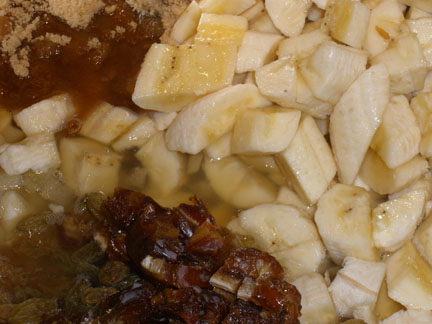
I then added (starting at one o'clock and moving clockwise in the pic to the right): 7 organic bananas (ripe but not mushy!) chopped into 0.5-inch pieces; 1 cup of chopped dates; 0.5 cups of organic Hunza raisins; about three big slices of candied ginger, chopped (the recipe called for 0.25 cups, but the organic ginger I bought could have been used to strip paint, I kid you not); 0.5 cups of brown sugar; 0.25 cups of molasses; and a teaspoon of salt. For spice, I added 0.5 teaspoons each of curry powder, cayenne, allspice, and ground coriander.

I simmered the mixture for 20 minutes until it was good and thick and syrupy. Towards the end, I was able to make a channel with my wooden spoon.The waftings that filled the kitchen were heady and complex - tangy, nose-curling aromas that provided a welcome savory counterpoint to the candy-shop sweetness of the banana jam that had gone before.

Do I see a vacuum there or am I going blind?
~Sting

Well, crystallized ginger and boiling vinegar are enough to bring tears to one's eyes!

I filled and processed my jars - but enough has already been said about THAT.

Next up: with still more bananas in my stockpile, I take a break from my jam sessions and do some spur-of-the-moment gluten-free baking.

Sunday, February 27, 2011

Decompression

Having submerged myself deep in my preserving pan all weekend, I am just now coming up for air. I have learned a great deal and produced eleven pints of quite excellent jams and conserves, if I say so myself. I had no real disasters and several notable successes.

And it was fun, too!

The final tally:
  • Banana jam with vanilla and three citruses: 2.75 pints
  • Banana, date, and ginger chutney: 2.50 pints
  • Clove-scented pear jam with pineapple: 1.50 pints
  • Pineapple and pear preserves with Cointreau: 1.50 pints
  • Very bitter lime and Meyer lemon marmalade:  2.75
I used four different varieties of jar and am now able to hold forth enthusiastically on the advantages and deficits of each: Ball quilted 8 oz; Ball quilted 4 oz; Leifheit 0.25 litres (which is really 8 oz, I now know); and Bormioli Rocco e Filio Quattro Stagione Vaso 70 mm diam (which also holds 8 oz or 0.25 litres or, in fact, 250 mLs). A pint's a pound the world around!

More details to come  - but first, I must readjust to life at sea level.


The fruits of my labors

There's Moleskine, again!
Sadly, he's in a bit of a dudgeon
and not speaking to me at the moment,
having this weekend been temporily forsaken
for a new black-covered Volant large-ruled 'jam' book.
I didn't want to risk getting Moleskine's
precious pages sticky, did I?

Wednesday, February 23, 2011

Saints Preserve Us

Having decided to make banana jam and secured a recipe from a trustworthy source, the time has come to admit outright an embarrassing personal secret, heretofore implied but not explicitly stated in my scribblings about fridge-a-lade and carrot jam.

I have never in my life vacuum-preserved a fruit or vegetable of any kind.

You heard me right -  difficult as it might be to believe, my existence so far has been utterly free of gingham aprons, cling peaches, jam pans, and all the other accoutrements of classic canning praxis. Of steam juicers, sterilization, wax seals, and Ball jars I know next to nothing.

In my current spirit of innovation, experimentation, and lifelong learning, however, I have decided to give it a whirl. My two new jamming books are chock full of detailed instructions for the novice putter-upper, enabling me to forestall the intimidating threats of bacterial invasion and botulistical outbreak. Having been pouring over theories and procedures for the last few days, I have decided that I have stumbled upon another one of those occult areas where practitioners propagate a certain mystique for their own complacent purposes.

Small-batch preserving doesn't appear to be all that difficult, frankly. In fact, it doesn't even seem to require much specialist equipment. I can use my biggest spaghetti pot to sterilize the jars; my round-bottomed stainless steel saucier to cook the mixture itself; a plastic chopstick for air bubble releasage (Japanese o-hashi are pointy, you know); and my best pair of rubber gloves for jar insertion into and retrieval from their infection-preventing sauna (I made a name for myself long ago with my remarkable asbestos fingers).

The trickiest part is the jars. You don't want to be taking shortcuts with those. I had been assured by Internet Experts that proper canning jars with rings and seals would be impossible to find at this time of year, but once again I was deceived. On a tip from The Diva, who knows all about such things, I presented myself at my local supermarket and was gratified to discover that they have canning supplies all the year round. I was directed to a little-visited corner of the produce section (little-visited by me, anyway) to find a veritable cornucopia of Ball jars in a variety of sizes and configurations. Of course, that didn't stop me from ordering online some extra-special and gorgeous European jars with olde worlde style for gift-giving and the like. A girl requires a certain amount of fanciness, after all - in her confiture if not her couture, if you get my meaning.

So far, the most recondite piece of information to which I have been made newly privvy is that jams, jellies, preserves, and conserves (words that I tend to use interchangeably to avoid those writers' bains, repetition and redundancy) are all quite different things. Who knew? Below, I offer a definition of each as a public service to readers who are curious about such arcana:
  • jam - crushed or chopped fruit cooked with sugar until it sets, often made from a single fruit
  • jelly - gelled mixture of sugar and juice, clear or opaque (OK, I knew that one)
  • preserves - whole or sliced fruits in syrup or soft jelly. UK English for conserves.
  • conserves - jam made from several ingredients, which may include two or more fruits and other ingredients such as nuts

Call the contents what you will, everybody I know will soon be flooded with home-made jars of seasonal scrumptiousness - organic where possible, utterly natural, chemical and preservative-free. Should the canning bug really take hold, I may be handing out JJP&Cs on street corners soon, inundated as I no doubt will be with marmalades, chutneys, ketchups, fruits-in-syrup, and confits of every description.

Keep an eye out - I'll be the crazy gal carrying a cardboard carton full of Bormioli Rocco jars and wearing a gingham apron.

Tuesday, February 15, 2011

Glass with Class

This past weekend, DMR - one of my most loyal readers - presented me with an elegant glass compotier. Perfect for fridge-a-lade, lemon curd, or any other home-made confiture or conserve you might care to name, it is far more aesthetically pleasing than the stockpiling solution I had been using previously, a plastic take-out curry container with the Sharpied® designation beef stock indelibly etched into its lid.


What DMR could not have known was the uncommon degree to which her cadeau was both timely and appropriate. Having just cleaned out the refrigerator of commercially-produced and gluten-polluted jars and bottles, there are now two entirely empty compartments in the right-hand door of the cold chest, waiting to be adorned with heavenly home-made preserves and condiments, free of the arcane labeling adopted by so many of our alimentary producers these days.

Given this blank slate with which to work, I am now seriously considering limiting all future storage to containers that, in the spirit of William Morris, are necessary, useful, and sublime.


For if beauty is truth, who needs the FDA?