Showing posts with label banana jam story arc. Show all posts

Sunday, March 6, 2011

Sauce a la Sir

Tonight, Sir made dinner.

Exhausted by my many and varied projects of late (jam! banana cake! more jam! oh - and I'm working weekends these days, too), I was getting ready to declare yet another night of Italian takeout when Sir magnanimously announced he would accept responsibility for the evening meal.

This offer was not entirely without its self-serving side. Loyal readers may recall that there has, in the back of my refrigerator, been mellowing and marinating a large container of duck confit, first placed behind the cheese box on December 9th and untouched since. Sir has been lobbying for the confit since, oh, the day it was made, but accepted reluctantly that the longer it sat the more unctuous and amazing it would become.

Tonight, he seized his chance.

Somewhat trepditatiously, we slowly heated the huge block of congealed duck fat in a low oven until we were able to excavate all the pieces without damaging them too much. The aroma wafting from the duck was delicious with, thankfully, no hint of spoilage. We shredded the legs but left the breasts in tact, because they seemed happy that way and looked very nice. I strained the fat through a cheesecloth-lined sieve and returned it to the fridge, where I will dip into it from time to time for various nefarious purposes. I then retired to my favorite toile-upholstered armchair with my Kindle while Sir worked his magic.

He heated the duck up in the oven to warm it, drain it of residual fat, and crisp the skin. He took some of the fat and roasted in it potatoes, which emerged from the oven crunchy and delicious.

He served the duck atop a pool of elegant sauce rouge: thick; slightly sweet; fruity and mysterious.

When pressed for details he was rather coy, truth be told, but the Squid and I managed eventually to winkle from him his recipe. Sir is not one for measuring ingredients, but he's fairly certain this is pretty much what he did:
  • First, he splashed about one-quarter cup (he thinks) of a rather impish Beaujolais Nouveau from the basement stores into a small saucepan and heated it up.
  • He added half a small jar of pear and pineapple jam (which would mean two ounces) to the wine and dissolved it into ruby red lusciousness.
  • Finally, he added his secret ingredient, by which he has sworn ever since first learning of its indispensability to the freres Roux, who used to keep supplies on hand in their Michelin-starred kitchens - an additional tablespoon of ambrosia to impart richness, depth and an enigmatic spice to the final coulis.


He is calling the dish Canard Charme avec Confiture et Catsup and exceedingly fine it was, too.

Saturday, March 5, 2011

Jam Session 4: Reprise

Finally!
Over, finished, gone, done, out.
~Anthrax

For the finale of my marathon preserving jam-boree, I decided to take all the limes I no longer needed for banana jam (having engaged in a last-minute change of plans) to make lime marmalade. I decided to add Meyer lemons because, well, I had them and it seemed like a good idea. I applied all the lessons learned from my previous batches regarding jars, temperatures, and gel tests and turned out two and three-quarter pints of bitter deliciousness in record time. I was already familiar with marmalade production, being a dab hand at fridge-a-lade when need arises, but had never gone the whole way and vacuumed my citrus preserves before. It was almost too easy.

1. I sliced my scrubbed fruit into very, very thin slices until I had four cups' total, divided evenly between limes and lemons. This was actually the most laborious part of the entire process, and taxed my sharpest knife and (admittedly modest) skills to the limit:


2. I added 4 cups of water and let the whole thing sit overnight. Normally, I do not bother with such a long soak, but limes have notoriously tough epidermides (is that right?).


3. The next day, I plopped the lot into my big pan and bubbled it for about half an hour, until the skins were soft.

4. I added four cups of sugar, decided the mixture was still a bit too bitter, and added some more.

5. I cooked it for another twenty minutes or so. When it reached 221 deg F on my candy thermometer, experience told me that I was not quite at the jelling stage. The liquid was not syrupy enough and it was still at a fairly rapid boil. A gel test in the freezer confirmed my suspicions.

6. When the mixture reached about 224 deg F, it appeared as though I was onto something. Another dollop that went into the freezer came out all puckery under the pressure of my right index finger. Huzzah!

7. I turned off the heat under the pan and continued to stir my unmistakably marmalade-y substance until it cooled a wee bit: this helped the suspension of the peel and forestalled the sort of floating-fruit catastrophe I suffered with my pear and pineapple preserve.

8. I decanted the mixture into my never-fail Ball jars, processed them for ten minutes, and was unsurprised to discover a vacuum dimple on every single lid.

9. The marmalade was bitter and delicious, with tender peel and jelly of the correct soft (but not runny!) consistency. The whole production (not counting the hour it took me to slice the fruit the day before) was over by noon.


I'm going to need a new challenge soon.

Next up: I perfect my recipe for gluten-free banana cake by using high-ratio baking principles and decide to make butternut squash preserves.

Friday, March 4, 2011

Jam Session 3: Pineapple Heart

La primera pregunta es:
Que es mas macho, pineapple o knife?
~Laurie Anderson

Given the size of the knife required for pineapple-butchering,
I'd say it is an even call.
~Fractured Amy

The third batch of preserves I created during my weekend jam-boree was billed in the recipe as Pear and Pineapple Marmalade: it was during this project that I experienced my first Problems With Pectin. Although these difficulties were observable and avoidable, I was too naive and inexperienced to spot the obvious signs of trouble in time to forestall their effects.

The recipe, from Linda Zeidrich's The Joy of Jams, Jellies, and Other Sweet Preserves, was simplicity itself. Take 1.75 cups of chopped and peeled pears, 1.75 cups of chopped pineapple, and 2.75 cups of sugar. Heat it all in a pan until the sugar melts and boil it until it's done. Process for ten minutes as usual.

Perhaps I'd become overconfident by this time, having previously defeated my vacuum demons and successfully set my banana jam. I breezelessly chopped my fruit and adorned the morsels with some grated lime zest for added interest:


I added two cloves for increased zip and heated everything up in my big pot. About halfway through cooking, however, I realized my fruit was not going to break down significantly (I admit it in retrospect: the word 'marmalade' in the recipe title should probably have alerted me to this danger). Realizing that my pieces were neither sufficiently small, tidy, or uniform to be very useful in a conserve where they remained in tact, I hurriedly ran the mixture through my food processor to make a jam, returned the whole lot to my pan, cooked it to 221 deg F (whereupon it was nice and syrupy) and that was that. Into my Leifheit jars (easily my least favorite of the entire weekend: not only did they suffer from the dreaded one-piece lid arrangement, but the rather Lutheran plainness of the glass failed to compensate with anything like the Italian style of my Bormioli beauties), processed, and done. The whole thing took less than an hour. The final product was slightly soft and loose, but I was satisfied that it would be entirely serviceable in yogurt or over ice cream.

But at this point I wanted marmalade, and still had remaindered over half a pineapple.  I returned to my fruit and repeated the process, this time exercising my knife skills to their utmost:


Into the pan! The problem was, when I got the mixture up to the required temperature, the liquid still looked a little bit watery - not thick and syrupy with large slowly-exploding bubbles. Still, the thermometer doesn't lie and I assumed I was missing some sort of subtle sign of doneness more easily discernible to a master preserver. I decanted the marmalade into my jars and was shocked - bewildered, even! - to see all the fruit float immediately to the top, rather like expired goldfish. It was horrifying. Nonetheless, I reasoned that after processing, all might still be well.

Ten minutes' worth of boiling later, still afloat.

I decided to wait until the next day. Maybe this was one of those preserves that needed time to set up properly?

Next morning, floating still. When I turned the jar upside down, it was clearly oozy and liquidy, not jelly-like as it ought to have been.

Did I despair? I did not. I had been advised to have a box of commercial pectin on hand for just such an eventuality (I know one of my initial principles was to use the natural jelling properties of the fruit in my recipes only, but clearly my pineapples and pears weren't up to the task). Thinking of poor souls just like me, the thoughtful makers of Sure-Jell [For Less or No Sugar Needed Recipes] even include inserts with their product detailing a procedure for 'saving' unjelled preserves!

Ten minutes later, I had several jars of lovely nuggets of pear and pineapple suspended in sweet viscousness. The lesson learned? Do not rely on thermometers for judging when a preserve is finished cooking, but always carry out a chilled-dish test to confirm (this is where you put some dishes in the freezer and, when you think your jam is just about ready, you put a small spoonful in one of them. Pop it back in the freezer for two minutes, and if the mixture puckers into a little mound when prodded with your finger, it's good to go for sure). Having said that, subsequent investigation revealed that both pears and pineapples have very low pectin contents: it's doubtful that without a huge amount of sugar and citrus juice the marmalade would have set fully whatever the case.

Another lesson learned: it's always good to have a backup plan.


Interesting-textured preserves look better in plain jars and vice-versa.
My smooth jam in the big old plain Leifheit vessel is a snooze-fest
- and would look far more exciting behind Ball's quilted glass,
where the marmalade resides.
A third lesson learned!

Next up: I apply all my newly-garnered practical experience to produce peerless lime marmalade in no time flat

Tuesday, March 1, 2011

Jam Session 2: Love in a Vacuum

It's a miracle we're all sane
We're kinda like sucked in a vacuum.
~Monster Magnet

Yes, we are - except when we're not.

I had myself some serious vacuum issues when I made my banana and date chutney on Saturday.

Having had a 100% success rate with the rings and seals on my admirable Ball jars during my banana jam production earlier in the morning, I decided for my chutney to try the most beautiful jars in my collection, purchased online at great expense from Rocco Bormioli and his filio. They were everything I wanted in my jars: the glass indelibly stamped with spring-like representations of leaves, flowers, fruits and happy bees; the shape - plump and round - reflective of the bounty within. They differed from the American jars in one important respect: their lids were irrevocably welded into a combined seal and screwtop arrangement, as apparently most, if not all, European jars' are.

In retrospect, I think this is a Bad Idea (unless you've learned jam-making under the tutelage of your nonna, I suppose), but as a novice maker of confettura I was blissfully unaware of these beautiful vessels' shortcomings. I was too carried away by their romantic pedigree: Bormioli have been making glassware since 1825, you know!

I whipped up a batch of the most delicious chutney ever and confidently packed the mixture into my glorious Italian vasi, leaving 0.5" of headspace as required by the manufacturer. I screwed on the one-piece lids and lowered the lot into the boiling tub, where they bubbled for the customary ten minutes. When I pulled them out again, three of the six lids were bulging in a noticeable, not to say seriously alarming, way. I hurried them to a secluded spot in the dining room, trusting they would not explode before I got them out of harm's way. After about ten minutes, during which they screeched and clanked (no subtle popping or clicking for these Italian rascals!) the three miscreants were no longer convex, thankfully - but depressed easily under the pressure of my right forefinger. Equally depressed, I mourned my first setback of the day.

I'm drifting in a vacuum of ideas, colors, movements, kapow! kapow!
~Biffy Clyro

Indeed.

I was ready to kapow! kapow! my head against the wall in frustration. Fortunately, the mixture was still hot and I had loads of surplus Ball jars. I hastily prepared a few, filled them with chutney, and processed them. Che gioia! Every single one safe and sealed under its happy dimple.

During all this pandemonium I learned some valuable lessons.
  • Ball jars' separate seal and ring attachment worked reliably for our grandmothers, and if it was good enough for them, it's good enough for me. Over two days, I did not have a single vacuum failure using their setup.
  • It makes good economic sense to go with these tried-and-true symbols of Americana. Not only do they cost about a two-thirds less than imported jars (plus they are available year-round, in a variety of sizes and shapes, at my local Giant supermarket), the seals can be purchased separately with ease. If one does have a vacuum failure, it is a simple and inexpensive matter to have extra lids standing by.
  • The rings themselves, if stored separately from the jars, will last a long time. Again, good financial strategy - and isn't frugality what home preserving is all about?

Banana and Date Chutney
(adapted from a recipe in Well Preserved, by Mary Anne Dragan)

In my big pot, I combined 1 cup of peeled, finely-chopped Granny Smith apples; 0.5 cups finely chopped sweet onions; 1.5 cups apple cider vinegar; and 0.25 cups lime juice (not sure how much the mixture would cook down, I tried to utilize my best knife skills and chop everything into uniformly little pieces). I brought the mixture to a boil and simmered it for ten minutes.

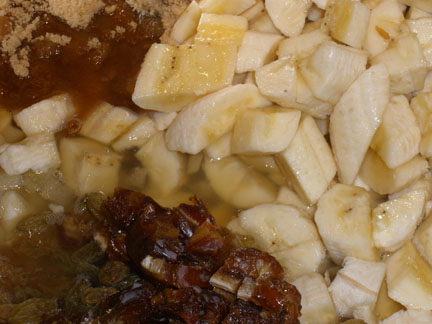
I then added (starting at one o'clock and moving clockwise in the pic to the right): 7 organic bananas (ripe but not mushy!) chopped into 0.5-inch pieces; 1 cup of chopped dates; 0.5 cups of organic Hunza raisins; about three big slices of candied ginger, chopped (the recipe called for 0.25 cups, but the organic ginger I bought could have been used to strip paint, I kid you not); 0.5 cups of brown sugar; 0.25 cups of molasses; and a teaspoon of salt. For spice, I added 0.5 teaspoons each of curry powder, cayenne, allspice, and ground coriander.

I simmered the mixture for 20 minutes until it was good and thick and syrupy. Towards the end, I was able to make a channel with my wooden spoon.The waftings that filled the kitchen were heady and complex - tangy, nose-curling aromas that provided a welcome savory counterpoint to the candy-shop sweetness of the banana jam that had gone before.

Do I see a vacuum there or am I going blind?
~Sting

Well, crystallized ginger and boiling vinegar are enough to bring tears to one's eyes!

I filled and processed my jars - but enough has already been said about THAT.

Next up: with still more bananas in my stockpile, I take a break from my jam sessions and do some spur-of-the-moment gluten-free baking.

Monday, February 28, 2011

Jam Session 1: Yes, We Have No Bananas

A word about the principles I adopted and challenges I set myself during my first-ever preserving project:
  1. I decided to make only seasonal jam, insofar as summer fruits are most definitely not to be had at their best right now. Of course, bananas aren't ripening on the tree in my corner of the world at the moment but they must be growing somewhere, mustn't they? Anyway, I do not believe their quality varies greatly with the time of year. Since home preservers typically work with citrus over the winter months, all my recipes made free use of this fine fruit family.
  2. I shunned recipes requiring commercial pectin, reasoning that the employment of Sure-Jell and the like takes all the challenge out of the proceedings. Where's the fun without a tingling uncertainly and the constant lurking threat of total ruination?
  3. I was determined to vacuum seal every jar I made, just to see if I could do it.
  4. To heighten the suspense and investigate their properties, I employed three different brands of jar, each with its own peculiar lid configuration.
Since banana jam was the raison d'etre for this whole canning catastrophe, I decided to start with a recipe from one of my iCookbooks that included raisins, limes, and ginger. Having foraged for and found all the necessary ingredients at my friendly local supermarket, I promptly threw my best-laid plans out the window when I received a last-minute e-mail from dear Toad, preserver nonpareil. She herself had just received a new jam book (via UPS, I assume, since it is definitely not Kindle-able: I checked), the English translation of Christine Ferber's magnum opus, Mes Confitures. Toad kindly forwarded to me one of Ferber's (many!) recipes for banana jam, which I decided I had to taste without delay. I made alternative marmalade plans for the limes, re-arranged my other priorities and ingredients, and set to work with a will.

My first batch of Jam de Banane was fabricated using a recipe more or less identical to the one in Mes Confitures. It took almost 24 hours total and was utter heaven when it was done. I used a variety of citrus fruits for their flavor and pectin content and chose for the final storage vehicle Ball jars from the good old US of A, with their cunningly separate seals and rings.

Here's how I did it.

I peeled ripe (but not mushy!) organic bananas until I had 1.5 pounds' worth in their nude state. I lost count, but I think there were about nine total. I sliced them into 0.5 inch rounds and arranged them in my big pot with 4 cups of sugar, citrus juice squeezed from 1 lemon, 2 tangerines, and 3 navel oranges, orange zest, and a scraped vanilla bean draped artfully o'er all.


I slowly, slowly heated up the mixture, stirring more or less constantly while the sugar melted. This took some time, so I entertained myself by humming all the while Ja, Wir Haben Keine Bananen, as sung by the geriatric East German cafe orchestra that serenaded Jimmy Cagney in One Two Three. Images of Horst Buchholz with his 'Yankee Go Home' balloons and Uncle Sam cuckoo clock danced through my head. This always happens when I think of bananas.


Back to business! I was awakened from my reverie to find my jam mixture had come to a simmer. I decanted it into a big glass bowl, covered the surface with parchment paper, covered the whole thing with plastic wrap, and let it sit quietly until the following day. 

It looked quite pretty in the morning sun!


At this point, the recipe became a little vague. The big question for this preserve concerned texture and appearance: the jam of my memories was smooth like a fruit butter, but these slices of banana were so attractive against the glass of the bowl that I considered leaving them the way they were, perhaps even including slices of the vanilla bean pressed against the outsides of the jars for extra fanciness. Sanity returned when I recalled that my organic vanilla bean had cost more than three dollars, necessitating that - in order to get my money's worth - I use and reuse it until the day I die.

Into the food processor for whizzing with the big metal blade! When the mixture was fairly smooth (with some pleasing banana bits for texture) I returned it to the pan and brought it to a boil. I cooked it, stirring frequently, until it reached 221 deg F on my candy thermometer, by which time it was also thick and syrupy.


Meanwhile, I had heated up all the canning accoutrements in various pots scattered about the kitchen, in readiness for my hot jam. There was a certain kerfuffle as I retrieved my jars from their hot water bath and tried to figure out the best place to work (I got into the groove during my second batch, and figured out an effective system for keeping lids, jars, and rings organized). I ladled the jam into my quilted jars, left the requisite 'head space' of 0.5 inches, wiped their sticky rims, popped on the seals, and screwed the rings finger tight. Back into the bath!


When the water reached boilage, I set my timer for ten minutes and cleaned all the spilled and sprayed banana jam off the floor, walls, and ceiling.


I retrieved my jars after their processing and put them on a wire rack to cool. I was cheered by their merry pinging as they settled into their vacuumed state.


When they were done popping about half an hour later, every single one sported a pronounced dimple, the proud badge of the successful American home canner.


I'm reluctant to open any of the jars, yet, having vacuumed every single one shut (astonishingly, given that Ferber is silent on the vital subject of yields, I cooked precisely the amount required for the 3 eight-ounce jars and 5 four-ounce jars I had prepared). I can tell you, though, that we licked the cooking pan utterly clean.

The jam was just as wonderful as I remembered.

Next up: I use some of my remaining bananas for an awesome chutney and discover the perfidiousness of Italian canning jars.

Sunday, February 27, 2011

Decompression

Having submerged myself deep in my preserving pan all weekend, I am just now coming up for air. I have learned a great deal and produced eleven pints of quite excellent jams and conserves, if I say so myself. I had no real disasters and several notable successes.

And it was fun, too!

The final tally:
  • Banana jam with vanilla and three citruses: 2.75 pints
  • Banana, date, and ginger chutney: 2.50 pints
  • Clove-scented pear jam with pineapple: 1.50 pints
  • Pineapple and pear preserves with Cointreau: 1.50 pints
  • Very bitter lime and Meyer lemon marmalade:  2.75
I used four different varieties of jar and am now able to hold forth enthusiastically on the advantages and deficits of each: Ball quilted 8 oz; Ball quilted 4 oz; Leifheit 0.25 litres (which is really 8 oz, I now know); and Bormioli Rocco e Filio Quattro Stagione Vaso 70 mm diam (which also holds 8 oz or 0.25 litres or, in fact, 250 mLs). A pint's a pound the world around!

More details to come  - but first, I must readjust to life at sea level.


The fruits of my labors

There's Moleskine, again!
Sadly, he's in a bit of a dudgeon
and not speaking to me at the moment,
having this weekend been temporily forsaken
for a new black-covered Volant large-ruled 'jam' book.
I didn't want to risk getting Moleskine's
precious pages sticky, did I?

Friday, February 25, 2011

A Deep Breath Before the Plunge

Well, nobody ever accused me of doing things by halves.

On Monday all I wanted was some banana jam. It is now Friday and, after five full days of planning, plotting, studying, and advice-seeking, my entire weekend will be given over to an orgy of chopping, stirring, sterilizing, and conserving to which the Kid Squid insists on referring as 'Jam Camp'. I shall be canning my little heart out for two solid days.

I have in the house quite a bit of fruit, since I had trouble choosing just one recipe from my two superlative new books. In addition, I have received a number of recipes from generous readers who know a thing or two about these matters. I have jars, lids, and organic vanilla beans (easily the most expensive part of this entire enterprise) standing by.

This is Fractured Amy signing off. I shall resurface in a couple of days, I trust, with tales to tell and jam to prove them.

Wish me luck.


Raw materials for Jam Camp.
Moleskine, warming to his new role in the limelight,
snuck into the frame when I wasn't looking.

Wednesday, February 23, 2011

Saints Preserve Us

Having decided to make banana jam and secured a recipe from a trustworthy source, the time has come to admit outright an embarrassing personal secret, heretofore implied but not explicitly stated in my scribblings about fridge-a-lade and carrot jam.

I have never in my life vacuum-preserved a fruit or vegetable of any kind.

You heard me right -  difficult as it might be to believe, my existence so far has been utterly free of gingham aprons, cling peaches, jam pans, and all the other accoutrements of classic canning praxis. Of steam juicers, sterilization, wax seals, and Ball jars I know next to nothing.

In my current spirit of innovation, experimentation, and lifelong learning, however, I have decided to give it a whirl. My two new jamming books are chock full of detailed instructions for the novice putter-upper, enabling me to forestall the intimidating threats of bacterial invasion and botulistical outbreak. Having been pouring over theories and procedures for the last few days, I have decided that I have stumbled upon another one of those occult areas where practitioners propagate a certain mystique for their own complacent purposes.

Small-batch preserving doesn't appear to be all that difficult, frankly. In fact, it doesn't even seem to require much specialist equipment. I can use my biggest spaghetti pot to sterilize the jars; my round-bottomed stainless steel saucier to cook the mixture itself; a plastic chopstick for air bubble releasage (Japanese o-hashi are pointy, you know); and my best pair of rubber gloves for jar insertion into and retrieval from their infection-preventing sauna (I made a name for myself long ago with my remarkable asbestos fingers).

The trickiest part is the jars. You don't want to be taking shortcuts with those. I had been assured by Internet Experts that proper canning jars with rings and seals would be impossible to find at this time of year, but once again I was deceived. On a tip from The Diva, who knows all about such things, I presented myself at my local supermarket and was gratified to discover that they have canning supplies all the year round. I was directed to a little-visited corner of the produce section (little-visited by me, anyway) to find a veritable cornucopia of Ball jars in a variety of sizes and configurations. Of course, that didn't stop me from ordering online some extra-special and gorgeous European jars with olde worlde style for gift-giving and the like. A girl requires a certain amount of fanciness, after all - in her confiture if not her couture, if you get my meaning.

So far, the most recondite piece of information to which I have been made newly privvy is that jams, jellies, preserves, and conserves (words that I tend to use interchangeably to avoid those writers' bains, repetition and redundancy) are all quite different things. Who knew? Below, I offer a definition of each as a public service to readers who are curious about such arcana:
  • jam - crushed or chopped fruit cooked with sugar until it sets, often made from a single fruit
  • jelly - gelled mixture of sugar and juice, clear or opaque (OK, I knew that one)
  • preserves - whole or sliced fruits in syrup or soft jelly. UK English for conserves.
  • conserves - jam made from several ingredients, which may include two or more fruits and other ingredients such as nuts

Call the contents what you will, everybody I know will soon be flooded with home-made jars of seasonal scrumptiousness - organic where possible, utterly natural, chemical and preservative-free. Should the canning bug really take hold, I may be handing out JJP&Cs on street corners soon, inundated as I no doubt will be with marmalades, chutneys, ketchups, fruits-in-syrup, and confits of every description.

Keep an eye out - I'll be the crazy gal carrying a cardboard carton full of Bormioli Rocco jars and wearing a gingham apron.

Tuesday, February 22, 2011

The Full Color Treatment

My yearning for banana jam has become so strong that, unless some appears in my kitchen soon, my life - and, I regret to say, the lives of those around me - will not be worth living. You know how it is: when something like that gets in your head, there's no shaking it until the hunger has been assuaged. And pity the poor soul who gets caught in the erstwhile maelstrom of discontent and high dudgeon.

For all our sakes, I am taking drastic action.

I related previously how, unlike my effortless research for carrot jam, I had a wee bit of bother finding authoritative internet guidance on preserving bananas. A search through my cookbooks had previously yielded nothing. Fortunately, I had one further means of data-trawling at my disposal - Amazon's wonderful 'Look Inside' feature, one of my favorite electronic conveniences of all time. In the time it takes to say Gigabyte! I was able to locate two promising-looking preserving books by sensible-sounding women who no doubt have the editors, test kitchens, and other paraphernalia required for Recipes that Work. Each of these books claimed to have at least one prescription for banana preserves.

Pay dirt!

It was the work of a nanosecond to have the works delivered wirelessly to my iPad, my preferred medium for electronic culinary references. My Kindle, although totally awesome in just about every conceivable way (I plan to be buried with it), doesn't do photographs or diagrams all that well. For example, Harold McGee is disastrously difficult to follow in his Kindled form, a state of affairs that just won't do when one requires the the scientific names of edible seaweeds, chemically-accurate representations of starch molecules, or the family tree of classic French sauces tout de suite. Cooking for Geeks, with its myriad text boxes and inserts, is similarly incomprehensible in the Amazon reader's configuration.

Resultingly, I felt that my new jamming books, including as they do photographs of setups and vital equipment - not to mention risque and libidinous depictions of luscious, quivering compotes and confitures - would be better suited to the whole glorious technicolor shebang, especially for a canning novice such as myself.

Now, although I have been berated for my slavish Kindle devotion by some of my nearest and dearest (not Sir, thankfully, who shares my passion as a loyal spouse should), more enlightened pals think it is just about forgivable to read eBooks, especially when travelling. On the other hand, nobody - but nobody! - can understand how I am able to abide my iPad in the kitchen. But really, it makes total sense. I don't have to worry about propping it open (and thus ruining the spine); if I splash goo all over the screen it's a simple matter to wipe it off (my dead tree copy of Delia Smith is positively crusty with residue, and while this might be seen by some as a suitable memento of cooking adventures past, I think it's gross); and the ability to download a chapter or two helps avoid the later-regretted purchase of a less-than-perfect cookbook.

And that is how, in less time than it took me to boil the kettle, I came to have in my possession trustworthy recipes for banana jam (with rum and raisins, no less - another use for my treasured Hunza beauties) and banana and date chutney. Not to mention gingered pear jam, red pepper orange jelly, sweet cherries in almond syrup, cantaloupe preserves with cinnamon, chestnut cream, and five-fruit ketchup - all courtesy of Mary Anne Dragan (the title of her book, Well Preserved, would have been too good to pass up under any circumstances) and Linda Zeidrich, putter-upper and preserver par excellence.

Thanks to this praiseworthy pair of pickling personages, Amazon, and my iPad, I should have banana jam in the pantry by Monday. And for that, the rest of the family can be truly thankful.

Monday, February 21, 2011

Web of Deceit

A number of readers have expressed their surprise that I should have been hoodwinked by Mark Hix, Clarence Court, and the unbaked creme brulee bamboozle. I would like to point out that, although I was fully cognizant of the custards' customary cookery procedure, I thought perhaps I was missing some trickstery shortcut that would make heating up my oven unnecessary. In my daydreams, after successfully producing six perfect desserts without resorting to water baths and hotboxes, I entered the pantheon of Those In The Know and became filled with the self-satisfaction that comes from recognizing truths that other mere mortals do not.

As I discovered to my chagrin, common wisdom was not - in this rare case - an oxymoron.

I blame the internet.

It's let me down a lot these days.

First, there was the small matter of trying to discover the gluten content of various prepared condiments and sauces so I could more effectively engage in the Great Refrigerator Purge. Gluten-free and allergy-related boards and fora are chock full of misleading, contradictory, and downright wacky information. Take one small example, Hidden Valley Ranch Dressing. Does it have gluten in it or doesn't it? Whatever you do, don't try to find out online: literally thousands of people have contributed to the debate, none of whom seem to have any real knowledge or understanding of what they are talking about. It's kind of insane - and does nothing for one's equilibrium during an already fraught enterprise. 

Then, there was the trivial-seeming issue of the pectin content in carrots. Easy, right? Three different internet authorities will give you three very different answers, I assure you, for what should (in my opinion at least) be a straightforward item of data.

And let's not forget the soy sauce debacle, which I have documented elsewhere.

I won't even begin to enumerate the other topics about which I have been forced to bang my head against the keyboard: lactose, broccoli, folic acid, magnesium - the list is neverending, a characteristic it shares with the copious amounts of wrongheaded information; well-intentioned (but hopelessly spurious and in some cases possibly dangerous) advice offered by Enthusiasts of All Descriptions; and sinister deceptions perpetrated by the Dread Agents of Agribusiness and Processed Foods and equally fearsome Promoters of Suspicious Supplements and Other Substances, with which the information superhighway is strewn. 

[deep breath] Now I have a whole new line of inquiry, to which the internet is adding nothing but confusion and woe.

Banana jam.

I want to make some and store it in pretty glass containers and eat it for breakfast. I have a dim memory from the distant past of straight-sided jars full of sweet and subtle tropical goodness that I used to slather on scones (this was prior to my gluten freedom-fighting career, of course). More than that I cannot remember. The preserve probably came out of the estimable boo-teek kitchens of Fauchon or Hediard, but further details are maddeningly elusive.

How hard could it be to produce such a conserve on my own stove? As with carrots, I thought I could do a quick trawl to establish general principles and then wing it. Unfortunately, given bananas' low pectin content, the issue is not straightforward. How much sugar is required? Do I need a gelling agent or do I not? What about the peel? These seemed like simple questions. Sadly, the only recipes I could find (quickly, it must be admitted, but I am an exceedingly efficient web researcher) varied wildly in their method and underlying theory.

Why is this?

Because the recipes are all written by bloggers. Bloggers, I tell you!

I never trust them.