Showing posts with label culinary experiments. Show all posts

Wednesday, December 28, 2011

Gifts of the Magi

It's been a banner year for Christmas swag a chez Fractured Amy, with three notable standouts on the culinary front.

  1. A copy of On the Line to sit beside last year's Ripertian addition to my Metro shelving. I am now in possession of much valuable intelligence, including the procedure for preparing unilaterally-cooked salmon (the fish 'develops a custard-like consistency!' swoons the author) as well as tempting recipes for corn sorbet, beurre noisette ice cream, and banana creme brulee -  all of which I shall be fabricating at the first available opportunity. Armed as I am with the bitter experience of last year's caramelized white chocolate panna cotta episode, I shall be sure to set aside several days for experimental purposes. Watch this space for exciting R & D updates.
  2. My very own one-pint cream whipper, complete with ten extremely cute but woefully non-biodegradable cartouches creme chantilly (better known to the geeks among us as N2O chargers). The sleek pressurized vessel and alchemical implications of this marvelous device appeal greatly to my engineering side and I am looking forward not only to the production of beaucoups espumas a la Adria but also Modernist mozzarella, a sort of water-balloon-like burrata squirted full of homemade fresh cheese, for which manufacture a cream whipper is de rigueur (Not incidentally, Myhrvold et al make heavy use of gaseous technology in their section entitled - fittingly enough - Foams. Who can resist something called Siphoned Souffle a la Lorraine? Not me, that's for sure!). Wanting to start modestly, I am currently debating what to make first - chilled zabaglione or Amarula and white chocolate mousse - and how to organize the recycling of the mountains of stainless steel cartouches that will no doubt soon be accumulating in my garage.
  3. A new T-shirt from the Kid Squid in stunning lab-coat blue. Inspired by one of his favorite games, the message emblazoned on its front is perfectly a propos - a tribute to the struggles of gluten guerrillas everywhere. I have worn it now for three days straight, such is my devotion to the truth of its message.


I plan to be buried in it.

Sunday, August 28, 2011

Damp Squib

Despite a fair amount of Irene-related devastation round and about, up here on the hill we escaped today's hurricane relatively unscathed. A flooded basement and some downed trees were about all we had to show for the storm of the century, which came and went with only a few half-hearted power outages to remind us that Big Things Were Afoot.

The good news is I can now confirm the Wolf works just fine in a blackout, thank you very much. I feel a bit disloyal for ever having doubted the sure-fired sturdiness of my splendid steely stove and have resolved never again to doubt its steadfastness in the face of storms and setbacks.

One problem I am left with, however, is the mountainous supply of non-perishable and hurricane-proof provisions I laid in late last week. The bottled water is no hardship, of course, and the Squid is quite content to live off instant ramen and mac and cheese from a box for as long as needs require. Over time we will happily deplete the chocolate and alcohol inventory and since the fridge was never off for any length of time our perishable items are - as they say - safe as houses.

But I also bought a few cans of sweetened condensed milk for our coffee. I discovered (rather late in the game) that - even in the face of calamity - Sir would rather take his coffee black than pollute it with tinned moo, so I was left with a bit of a conundrum. The milk sat on the kitchen counter all day today, daring me to take some sort of action.

In the time it takes the Coriolis force to develop into a full-blown cyclonic vortex, I had it. Banoffee sauce! You know the stuff: it's the rich, dark, dulce de leche-type substance used as a pie filling with a digestive-biscuit crust, sliced bananas, and mountains of whipped cream. These days traditional pies are off the menu here a chez Fractured Amy, but the sauce has innumerable additional applications. One can make like Jamie Oliver and serve it as a 'mess' with crushed-up meringues, cream and fruit. Top it with bruleed bananas and you've got something really special. Glop it over ice cream or use it as a dipping sauce for apples.

One can even, I believe, it eat straight from the spoon, but I could not possibly confirm such an outrageous rumor. For a gluten freedom-fighter to engage in such greedy behavior would show an utter lack of self-control and disregard for lady-like deportment, wouldn't you agree?

To my knowledge there is only one bona fide way to make banoffee sauce. You take a can of condensed milk and put it on a plate, which you in turn place on the bottom of a big saucepan. You fill the pan with water so the can is completely covered and slap a lid on it. Bring the water to a boil, then reduce the heat and simmer it for the rest of the afternoon. Take care not to let the top of the can peek above the water level and in several hours you will be rewarded with fourteen ounces of thick, unctuous caramel goodness.

Oh, I know that some people of an unscientific mien are apt to warn would-be banoffee busters that the can will explode all over the wallpaper if they dare try this time-tested and traditional method. The internet (of course) is full of counterfeit procedures for the over-cautious cook, such as decanting the milk into a water bath for cooking in the oven or even - horrors! - using prepared dulce de leche from a jar.

Stuff and nonsense! I grasped one of the cans firmly and prepared to peel off the label in preparation for its submersion. Guess what met my eye?


Even the manufacturers are climbing aboard the bandwagon of timorousness! How they can justify financially the discouragement of a vital use for their own product I have no idea. I admit, though, to a second of hesitation. Was my luck about to run out, forcing me to scrub molten caramel off kitchen surfaces for all eternity?

I decided to risk it. Since disaster-wise I'd already dodged one bullet this weekend, I resolved boldly to face another and let the banana chips fall where they might. After all, life is just that much more sensational when a bit of danger is thrown into the mix.

Having done the deed, I confess that an hour or so later my confidence waned somewhat. Was it my imagination, or did we all find urgent tasks elsewhere while the pot simmered malevolently on the back burner? I went for two walks to survey damage in town (our local creek will probably burst its banks later tonight, but otherwise the place was quiet this afternoon) and spent a fair amount of time picking up plums and downed branches from the lawn. Sir decided to work upstairs in the farthest reaches of the house and the Kid Squid hid in his room, ostensibly getting himself emotionally prepared for the first day of school (since postponed). Every so often I went to check on the water level in the pot, standing at some distance and tentatively nudging the lid with my longest pair of metal tongs.

But - again! - I need not have worried. At four o'clock I removed the still in-tact can from its bath and, after waiting for it to cool a bit, pulled back its ring tab to survey the elixir within.


Perfection! And with nary a pop or hiss to justify all the scaremongering. We celebrated with great lashings of sauce straight from the spoon.

A practical and family-pleasing use having been found for the condensed milk, I am now left only with my twenty-four hours' worth of surplus butane, which - given its own explosive potential - I would rather not have hanging around the house for too long. Since the cans fit handily on my chef's torch, I foresee a good deal of bruleeing in my future (in addition to the bananas above, there's always traditional creme brulee - now perfected - as well as Modernist Cuisine's recipe for Parmesan Creme Brulee with Onion Sugar, the next egg experiment on my docket).

I suppose I could always take my portable burner camping (there's a first time for everything!) and use the butane in the manner for which it is intended, but that would necessarily require that I venture outdoors.

And haven't you heard?

The weather scares me.

Saturday, February 19, 2011

Burnt Offering

The spheres aligned in such a way that I made Creme Brulee for the first time ever this week. It took several hours over two days and by the time I was finished I'd almost forgotten why I started. As I recall, the train of thought that led to my caramelized custard caper went something like this:

  1. Hmmm. I have many, many egg yolks left over after baking the gluten-free Cake for a Very Special Occasion. Whatever shall I do with them?
  2. I know. I will check the recipes at Clarence Court's elegant website. If they can't tell me what to do with my yolks, nobody can.
  3. Why - here's one! Creme brulee! What better way to christen my brand new chef's torch, residing as yet untried in the string drawer in the kitchen?
  4. As an added bonus, I will supplement my repertoire with another gluten-free dessert.
And so on. When I finally settled down and examined the recipe, I was somewhat taken aback. Although I have never fabricated creme brulee in my life, I am not unfamiliar with the procedure. What could be easier? You make a thick vanilla custard, sprinkle some sugar on top, zap it with some fire, and everybody wins.

Sigh.

My first concern was that the Clarence Court recipe, unlike every other for creme brulee I have seen, does not call for the custard to be baked. I was suspicious because the recipe itself is weirdly repetitive and contradictory once you get to the key bit about cooking the custard.

I checked the recipe's pedigree, to see if there was anything strikingly bizarre about its origin. Although the blurb mentioned an English version called Trinity Burnt Cream (characterized by a lack of vanilla and less general sweetness), the recipe on the CC website claimed to be for the actual genuine Froggy article. The author, Mark Hix, is a prolific English cookbook writer and celebrity chef, so I guess you could say his credentials are in order, apart from the French part. According to Wikipedia, Hix served Keith Floyd his last meal before the latter expired of a heart attack a few hours later, although foul play was not suspected (the subsequent offering on his restaurant menu of Keith Floyd's Last Lunch struck some as ghoulish, or at least in very poor taste - but it's the sort of thing I would do if I had a restaurant of my own. Make of that what you will - particularly if you are planning to come to my house for dinner.)

Anyway, it looked as though Hix knew what he was doing brulee-wise, so I decided to give the recipe a whirl. The proof of the custard is in the jiggle, I always say!

I followed the recipe to the letter, whipping up a batch of vanilla-scented creamy goodness and heating it in my round-bottomed saucier until the mixture was very thick and hot. I chilled it quickly by whisking it in a bowl set inside another bowl of ice (a trick garnered from Julia); poured the eggy elixir into ramekins, which I popped into the newly spacious fridge to spend the night.

The next morning, when I tipped one of the dishes expectantly to see whether it had set during the wee hours, several tablespoons of sweet deliciousness slopped out all over my slippers. Nope - definitely not the correct texture.

As I drove to work I pondered my misfortune. Perhaps the creme would miraculously stiffen up when I attacked it with my blowtorch? Not wanting to be prejudiced too quickly against what I shall call The English Method and ever eager for new experimental challenges, I decided to engage in some R&D when I got home. I would bake some of the custards in a water bath before setting them alight and brulee the rest as they were, thus establishing empirically which method produced the more glorious (or at least, more successful) dessert.

Later that afternoon I resumed the trial. Two of the ramekins I left alone. I popped the remaining victims into a roasting pan filled halfway up with boiling water and baked them at 325 deg F for half an hour (as per destructions in the big yellow Gourmet cookbook). When the cremes were firmer (but still wobbly when set upon with tongs) I removed them from the hotbox and stored them in the garage so they could cool quickly.

Then, the moment I had been waiting for! I sprinkled each of the custards with organic turbinado sugar left over from my fridge-a-lade project and - with a gleam in my eye and arson in my heart - I barbecued them with my fabulous new toy. It took a little practice, but was terribly terribly extremely fun to do.

When they were all bubbly and brown and the kitchen smelled like a cotton candy booth I popped the ramekins back in the fridge until dinner time.

They looked awesome, if I say so myself.

After dinner, we addressed our desserts in the proper spirit of inquiry and constructive criticism. In all cases, the burnt sugar crust shattered in precisely the required manner when tapped with a spoon. The baked custards were creamy and soft, but held their own under their caramelized topping. My only niggling complaint was the vanilla flavor - not having any vanilla beans on hand I used extract (albeit very good extract), which just isn't the same. Lesson: always use vanilla beans in creme brulee.

The unbaked custards, prepared according Mark Hix's instructions, were all wrong. They were more sabayon than custard, and the texture was not sufficiently robust to withstand the challenges of the brulee. We scraped all the crispy bits off the tops and munched them happily while declaring his recipe's English Method a failure.

The moral of my story is Always Bake Your Creme Brulee.

 And beware of Englishmen bearing French recipes.

Monday, January 3, 2011

Oven Roast

Previously, in Fractured Amy's kitchen ...

I discovered when roasting white chocolate a la Eric Ripert and Michael Laiskonis that the unwary novice may easily come under the impression that disaster has struck and feel the need to implement a Backup Plan to ensure there will be dessert for hungry diners.

Following my fraught but ultimately successful fabrication of Caramelized White Chocolate Panna Cotta. I did some experimentation to discover where I (or indeed, the recipe) might have gone wrong. I discovered that there was nothing amiss with my oven thermostat or my white chocolate, but that the fault lay with my baking vessel (the material for which was unspecified in the recipe); the recipe's stipulated timing (which was completely off); and Chef's silence about the dismaying things that happen to white chocolate when you roast it.

Well, I can reveal this last secret now - and it makes total sense if you think about what is happening in the oven. I have written of the glories of the Maillard reaction before and foolishly did not consider its implications for the caramelization of my chocolate. For any browning of the milk solids to take place, it was of course first necessary to evaporate all the moisture - hence the chocolate's alarming transmogrification from creamy dreaminess to grainy goop. What appeared to be the same sort of seizing that betokens ruination for most chocolate applications was, in this rare case, necessary and desirable. While it's true that with a certain amount of logical deduction I might have realized this on the day, I was too caught up in anxiety to think clearly at the time. A bit of explanation and/or warning in the recipe would have saved me a good deal of trauma.

During my experiments I tested different sorts of baking vessels to see if they made any difference to the final result. The answer was an unequivocal yes. When I first made the dessert I had used a Pyrex baking dish, which resulted in a cooking time of just over an hour (more than twice the time stipulated in the original recipe). I found I could most closely approximate Eric's estimates by using an enamelled cast iron gratin dish, but even then elapsed oven time was 40% longer than promised. A note to that effect in Avec Eric might have proved comforting.

In addition to these obvious difficulties, I was unable to duplicate the recipe in the book exactly due to limitations beyond my control: the ingredients list called for sheet gelatin (like most home cooks, I had only packets of powder on hand) and whole milk (which I never have in the house). I therefore had to adapt the recipe somewhat to suit the ingredients available. It is this modified recipe that I present, below.

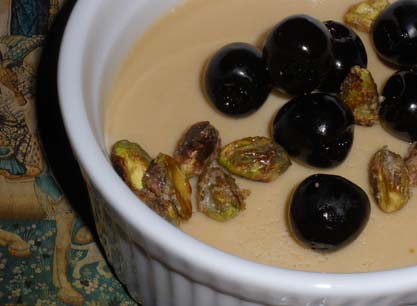
The original recipe called for a garnish of blood orange marmalade. While this sounded like a delicious addition to the dessert, I decided to challenge conventional wisdom and make use of items I already had in the house, viz. amarena cherries left over from Christmas dessert. I heated them in a pan with butter and brandy and poured them on top of the panna cotta just before serving. I also scattered on some sugared pistachios for crunch and color. The result was heaven.


I hereby present readers with (dare I say it?) a new, improved, and foolproof recipe (including warnings, provisos, and issues arising) for ...

Caramelized White Chocolate Panna Cotta (after Eric Ripert)
  • 6 oz very good white chocolate, in small pieces
  • 1.25 teaspoons powdered gelatin (approx. half an envelope)
  • 1 cup heavy cream, in a microwavable pitcher
  • one-quarter cup 2% milk, in a small bowl
Heat your oven to 300 deg F. Place your chocolate in a heavy baking dish and roast for fifteen minutes. Give it a good stir. Keep roasting, stirring every ten minutes or so, until it's grainy, lumpy, brown, and unappetizing (picture). It will become very stiff - make sure when you stir it you scrape every bit off the bottom and sides of the baking dish, or it will burn. In my experience, cooking time is anywhere from 35 minutes (enamelled cast iron) to one hour (Pyrex). Different baking dish materials may render even more variable results.

When it seems that the chocolate is almost ready, sprinkle the gelatin onto the milk to soften.

Heat the cream in your microwave. As soon as it boils, remove it and let it cool just until it stops bubbling. If it's still boiling when you pour in the milk/gelatin, you will have unfortunate results.

Slowly dribble the cold milk/gelatin into the hot cream, whisking madly all the while. Quickly retrieve your white chocolate from the oven and transfer it to a mixing bowl. Carefully add the cream mixture, very slowly at first, so that the white chocolate dissolves utterly and there are no lumps. Some vigorous work with a spatula is required to burst the granular particles and achieve smoothness.

When the mixture is cream-like again, pour it into dessert ramekins and cool on the counter. When it achieves room temperature, cover tightly with plastic wrap and store in the fridge to set, three to five hours.

The recipe says it will make four desserts, but we found the panna cotta to be very rich and will henceforward be dividing it among six dishes.

Next up: I reveal the Backup Plan

Friday, December 10, 2010

Spud Busting

Ardent readers know that I am a big potato booster. The humble tuber has provided welcome starch-laden succor in my gluten-free hour of need, its well-known fibrousness proving a boon in these breadless times. I admit, however, that I don't think too much about my spuds and their provenance - I buy them (Russets at this time of year, mostly) in batches of eight or nine and they usually cost around ninety-nine cents per pound. I bake 'em and mash 'em and sometimes get fancy, but most of the time we eat them and forget them. We love them the way we love the sunrise, or Spring daffodils, or the twists and turns of Lost - while appreciating their fabulosity, we also tend to take them for granted.

Recently, however, potatoes hit my consciousness like a 50 lb. burlap sackful falling unexpectedly off the back of a pickup truck. It happened like this. Finding that the NYTimes online was updating me on Julian Assange and the marvelously scandalous Wikileaks commotion with insufficient celerity, I was reluctantly forced to log onto CNN for the breaking story. Would Blondie turn himself in? Would the British judge offer bail? What about extradition to Sweden? Gripping stuff - and my rapt attention was such that I almost missed the wee promotional link off to the side, promising with some urgency to reveal what seven foods I must never, ever, under any circumstances feed my family.

I saw the link just in time and duly clicked. Now, I have written before (and at some length) that I have not traditionally been into earnest food as a rule and that is still the case. However, I must admit that all of this watching-what-I-eat business has wrought a few changes in my life: I cook brown rice now and consume chia seeds for breakfast. My intake of saturated fat is way, way down and I'm feeling slightly better, I suppose, as the Nutritionist predicted. For some time I've tried to buy organic proteins where possible and I've always kept processed food to a minimum. Seven foods one must avoid like the plague? I guessed that, in a typical week, I didn't buy any of them. I prepared to scan the List of Doom and congratulate myself on my canny shopping habits and healthy lifestyle.

Well, campers, you will have guessed the cataclysmic truth. Of the seven foods most likely to kill you and destroy the planet (as identified by Prevention magazine, brought to us by the very sincere folks at the Rodale Press just up the road), four to five are regularly (if not commonly) to be found in my recycled Wegmans shopping bag.

Good news first. I never buy canned tomatoes or microwave popcorn. At least I'm off the hook there. Farmed salmon is something I already knew was evil evil evil, but sometimes I can't bring myself to pay $24 per pound for wild-caught fish and one can only eat so much tilapia in a given week, am I right?

This leaves milk, corn-fed beef, apples, and potatoes. It is potatoes about which I am choosing to vent my spleen, because that is the thing on this list of which I eat the most. Milk makes me gag (except in tea or coffee); beef we eat only on the rarest of occasions; and I'm more of an Anjou pear girl, anyway. Tatties, now - that gives me serious pause.

Here's the scoop. According to Jeff Moyer, Chair of the National Organic Standards Board, most commercial potato farmers will not eat their own product, preferring to grow their families' supplies in separate organic plots. This is because the tubers (underground growers that they are) absorb the herbicides, pesticides and fungicides that are spread in the fields to increase yields. In addition, spuds are treated after harvesting with chemicals designed to keep them from sprouting during storage. Quite apart from the sad impact this treatment must inevitably have on bonsai potato artistes worldwide, it is claimed that no amount of scrubbing can remove these noxious substances once they have been absorbed into the taters' flesh.

Be afraid. Be very afraid.

I am not usually an alarmist where food is concerned, so in addition to all my other kitchen experiments (gluten-free baking, molecular gastronomy, and no - I haven't forgotten that the pasta situation is still unresolved) I will be testing the theory that you cannot sprout a commercially-farmed, chemical-filled potato. I currently have three specimens strategically placed in the basement: one organic russet, one non-organic russet, and one strange waxy potato I bought by mistake last week that I'm sure is full of fungicides and DDT (it has that look about it). I will check on their progress regularly and update readers with the results when I have them. I will be most relieved if the malevolent potatoes do, in fact, sprout - organic potatoes cost $1.40 per pound and I'm not sure the bank balance can stand them for long.

Friday, October 8, 2010

Weight Watching

Affronted readers (hopefully not those same activists who are currently making the news with their vow to abolish the hallowed Bureau of Weights and Measures) have taken issue with my use of ounces rather than cups when measuring dry ingredients (Mad About Madeleines: Deuxieme Partie). 'Why would you forsake the volumetric measurement method, legacy of our brave pioneer foremothers?' I hear them [the readers] cry. Clearly, some explanation for my eccentric behaviour is required.

To begin with, I must reveal that my formative cooking years were spent in a country where cups as a unit of dry measurement were (and still are) unknown. My first cookbooks, many of which are still in heavy use, relied exclusively on pounds and ounces (they weren't metric, thank goodness, or my head might have exploded) and kitchen scales have thus been a fixture on my kitchen counter since time immemorial. I remember hearing somewhere (Good Eats, maybe?) that cooks in very few countries other than the United States use volumetric measures as a matter of habit. I seem to recall that one of them is Iraq - make of that what you will.

The second reason is pure pragmatism. I had determined during my extensive madeleine R & D that the amount of g/f flour was crucial to the quality of the finished cakes, yet found this same flour had the annoying habit of clumping and concealing air pockets in its measuring vessel. Plus, every time it was sifted, it cunningly changed volume, as follows:

 Gluten-free flour volumes (initial amount straight from the bag: one cup or 48 tsp)
  • Sifted once: 66 tsp (38% increase in volume from original cup)
  • Sifted twice: 71 tsp (8% increase from first sift)
  • Sifted thrice: 72 tsp (1% increase from second sift)
The final volume of 72 tsp represents an incredible 50%  increase from the original cup! You can't make this sort of thing up: I was actually pretty stunned by this margin for measuring error.

Needless to say, the weight of the flour during these shenanigans remained a reassuringly constant 5.25 ounces. I concluded that measuring by weight was the only sensible recourse, allowing the baker to sift with impunity, carefree in the knowledge that the final recipe would only be improved by her diligence. I stick by my decision, and will be watching my weight during the upcoming pate a choux studies, due to commence this weekend.


my konstant kitchen kompanion

Next up: an agonizing choice - profiteroles or gougeres?

Sunday, September 26, 2010

Official Report of the Spaghetti Committee

Background
During the preparation of a recent dinner, it seemed that Spaghetti Style gluten-free spaghetti cooked differently than Barilla durum wheat spaghetti, viz. equal amounts of the dry product appeared to yield different amounts of cooked pasta. This anomaly was in direct contravention to the manufacturers' claim that, in both cases, two ounces (dry weight) constituted a single serving of pasta. Given the serious consequences for consumers' satisfaction and fullness index, it was deemed necessary to perform further testing at the first available opportunity.

Test plan and execution
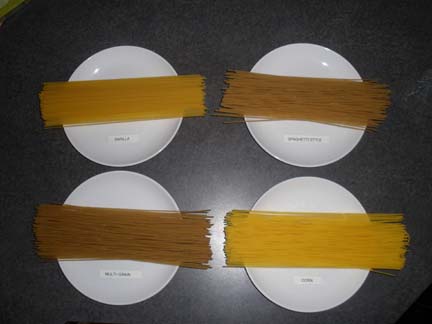
Four different brands of spaghetti were acquired from the supermarket, as follows: Barilla traditional semolina and durum wheat spaghetti (the control); Pasta Joy Spaghetti Style with Rice Bran (Brown Rice Pasta) (see previous post); De Boles Multi Grain Spaghetti Style pasta (a mixture of brown and white rice flours, amaranth flour, quinoa flour, and xanthan gum); and De Boles Corn Spaghetti Style pasta (100% yellow corn flour).  Except for the Barilla, all the noodles were certified gluten-free.

Equal amounts of dried pasta were carefully measured (dry weight = 113.4 grams or 4 oz.) and labelled as follows:


A simple displacement setup was engineered and the respective volumes of pasta (dry weight) established:


Each variety was then cooked according to the manufacturer's instructions. At the end of cooking, the weight and volume were measured again. Note was also taken of overall appeal.


Results
Equal dry weights of pasta yielded different uncooked displacement volumes, detailed below. In all cases, both volume and weight increased during cooking, although there was considerable variation from brand to brand:

Barilla. Initial weight: 113.4g. Cooked weight: 283.5g. Initial disp. volume: 120ml. Cooked disp. volume: 300ml. Increase in weight: 150%. Increase in volume: 150%.

Spaghetti Style. Initial weight: 113.4g. Cooked weight: 205.5g. Initial disp. volume: 100ml. Cooked disp. volume: 200 ml. Increase in weight: 81%. Increase in volume: 100%.

Multi-Grain. Initial weight: 113.4g. Cooked weight: 198.4g. Initial disp. volume: 88ml. Cooked disp. volume: 200ml. Increase in weight: 75%. Increase in volume: 127%.

Corn. Initial weight: 113.4g. Cooked weight: 212.6g. Initial disp. volume: 98ml. Cooked disp. volume: 225ml. Increase in weight: 88%. Increase in volume: 130%.

Discussion
Initial suspicions that g/f pasta cooks differently from traditional varieties were confirmed. All the pasta increased in both weight and volume during cooking, rendering groundless the earlier fear that some of the Spaghetti Style had somehow disappeared out the ventilation fan (this observational error may be explained by the fact that of all the noodles, the Spaghetti Style's volume increased the least). The Barilla's increase in weight and volume (a whopping 150% in both cases) was unmatched by any of the g/f products, with the corn pasta trailing in second place with an 88% increase in weight. To match the final desirable Barilla weight (cooked weight being deemed more important than volume when evaluating the fullness index) would require 156g of Spaghetti Style; 162g of multi-grain; and 151g of corn.

Of the three g/f varieties, the corn pasta was a clear winner in texture and taste - although it more resembled capelli d'angelo than spaghetti. This detail was of little consequence, however, since the Kid Squid reported he would happily eat a bowlful with his favorite sauce (a rash statement that will be tested for veracity later this week: reportage to follow). The Spaghetti Style has been described elsewhere. Of the mult-grain pasta, the less said the better: it tasted as unpleasant as the picture above suggests (the multigrain is the slimy pile on the lower left)  and will not be gracing my pantry shelves any time soon.

Next up: We discover we're sick of pasta and decide to have chicken curry and basmati rice for dinner.